


Why Raw Hair Bundles Are Never Identical
Your bundles arrived and they are not identical. One is very slightly warmer in tone than the other. The wave pattern on one is a little looser. Sitting in your hands they do not look like the three matching bundles in the product photo.
This is the most common thing people contact us about, and in almost every case it is not a fault. It is the clearest evidence you have that the hair is genuinely raw.
Why raw hair varies
Raw hair is unaltered. It has not been acid washed, dyed to a uniform shade or steamed into a single curl pattern. What you receive is what grew on somebody's head, and hair that grew on somebody's head is not uniform. Your own is not.
Three things vary, and all three are normal.
Colour
Natural hair is rarely one flat shade. Most raw hair runs somewhere between natural black and deep brown, and it can carry warmer or cooler tones depending on the donor and on where the hair sat on their head. Ends that have seen more sun read lighter than roots. Between two bundles from different donors, a slight difference in depth is expected.
Texture and wave pattern
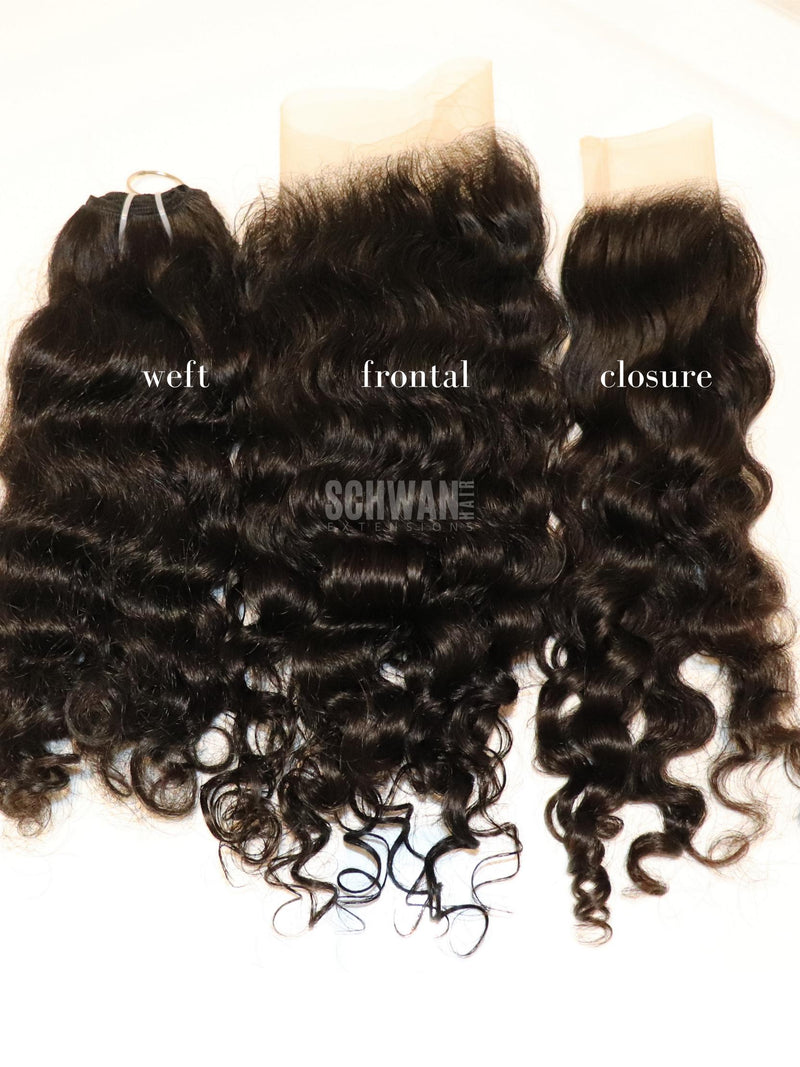
Two bundles described as wavy will not have an identical wave. One may be looser, one tighter, and both may sit differently again once washed and air dried. Raw hair shows its own pattern after washing rather than the pattern it was packed in, which is why hair can look different on arrival than it does after the first wash.
Density along the strand
Single drawn hair thins toward the ends because the strands are naturally different lengths, exactly as your own hair does. Double drawn hair has the shorter strands removed by hand so the thickness carries further down. Both are normal, they are different products, and the difference is explained in single drawn vs double drawn.
Uniformity is the warning sign, not variation
This is worth turning around, because the industry has trained people to expect the opposite.
Hair that is perfectly identical across every bundle, in a flat jet black, with a mathematically consistent curl pattern, has been made that way. It has been stripped of its cuticle, dyed to a single shade and steam processed into a uniform texture. It looks superb on arrival and it reverts, because the texture was never the hair's own.
So when three raw bundles differ slightly, that is the hair telling you it came from real people and has not been processed to hide it. If you want to understand how to verify that properly, read how you can tell if hair is raw.
How to get a seamless install anyway
Natural variation is a feature, but you still want the finished head to look like one head of hair. Here is how.
Order your bundles together. Bundles bought in one order are far more likely to come from the same or a closely matched donor. Ordering a fourth bundle three months later is where mismatches genuinely happen.
Buy the closure or frontal at the same time. A closure or frontal sits at the front where any difference is most visible, so match it at the point of purchase rather than later.
Mix the wefts through the install. Do not install bundle one at the nape, bundle two in the middle and bundle three at the crown. Alternate the wefts through the head and any variation disappears into the blend instead of sitting in bands.
Wash before judging. Hair is packed after handling and travel. Its true texture shows after a clarifying wash and an air dry, not out of the packet.
Let a colourist even it out if you want uniformity. Raw hair takes colour well because there is an intact cuticle to work with. A toner can bring two bundles into line. Be aware that colouring opens the cuticle and shortens the hair's life, which we cover in how long raw hair lasts.
When it is actually a problem
Variation is normal. These are not, and you should contact your supplier:
- Hair that tangles or matts from the first wash, which suggests mixed donor hair with cuticles running in opposite directions
- A bundle noticeably short of its stated weight
- Texture that drops out completely and permanently after one wash, which points to steam processing
- A colour difference so pronounced that the bundles are obviously different shades rather than different tones
If you have any of those from us, tell us and we will sort it. Our returns policy is published and you can read it before you order.
The short version
Slight differences in tone, wave and density between raw bundles are expected and are a sign of authenticity. Order your bundles and your closure together, alternate the wefts through the install, and judge the hair after a wash rather than out of the packet.
Browse raw hair bundles, or use the hair finder if you are still choosing a texture.