


How Can You Tell If Hair Is Raw?
Almost every hair seller now uses the word raw. There is no certification behind it, no standard to meet and nobody checking, so the label on the listing tells you very little. This is how to actually tell whether hair is raw, before you buy it and after it arrives.
The short answer
You cannot tell from a photograph, and you usually cannot tell from the product page. What you can do is ask questions that a reseller cannot answer, and run two simple checks once the hair is in your hands. Genuinely raw hair is single donor, unprocessed, and behaves like hair rather than like a product.
Before you buy: five questions
1. Is this single donor or mixed donor?
This is the question that separates raw from everything else. Raw hair comes from one donor per bundle, so the cuticles all run in the same direction. Mixed donor hair is collected from many sources, and where cuticles run against each other, the hair tangles and matts. A seller who does not know how many donors are in a bundle is not sourcing the hair themselves.
2. Where specifically does it come from?
Not "Asian hair" but the actual region, and why they buy from there. We can tell you that our Indian hair is sourced from temples in South India, handpicked one donor at a time. A reseller working from a drop-shipping catalogue cannot give you that answer because the information does not exist on their end.
3. Is the texture natural or steam processed?
Steam processing forces a texture onto hair that never grew that way. It looks convincing in the shop and it reverts after a few washes, permanently. If a seller offers one origin in six perfectly uniform curl patterns, those patterns were manufactured.
4. Is it single drawn or double drawn, and what does the bundle weigh?
Both are legitimate, but they are different products at different prices, and short weight bundles are common. A real supplier answers this instantly. You can read the difference in single drawn vs double drawn.
5. What happens if it is not what I expected?
A returns policy you can read before you order is a business. No returns policy is an account with a payment link.
Warning signs on the listing itself
Every texture, every length, always in stock. Single donor hair does not work that way. Permanent full availability across a wide range is factory stock.
The price is far below everything else. Raw hair is limited by how much one person grew. Our own bundles start at £115 and climb with length. Hair advertised as raw at £40 a bundle is something else wearing the word. We break down realistic pricing in how much raw hair costs in the UK.
The claims are too good. If hair supposedly holds any texture, takes any colour, and never reverts, that is not raw hair being described. Raw hair has one natural texture and it returns to it. A seller who tells you what the hair cannot do is a seller who knows what they are selling.
Unnaturally uniform colour. Real single donor hair varies subtly along the strand and between bundles. A perfectly flat jet black across every product is usually a dye job over stripped hair.
Once it arrives: two checks
The wash test
This is the one that settles it. Wash the hair with a clarifying shampoo and let it air dry without product. Raw hair will show its own natural pattern, and that pattern will be slightly irregular, because hair is. Processed hair does one of two things: it loses the curl it was sold with and dries limp and straight, or it roughens and starts to tangle as the silicone coating comes away.
Most sellers will not take a return on washed hair, so do this on one bundle, not the full set.
The feel test
Run your fingers down a strand and then back up it. Raw hair has a very slight directional resistance going up, because the cuticles are intact and aligned. Hair that feels identically slick in both directions has usually had the cuticle stripped and been coated to compensate. That coating is also why heavily processed hair feels best on day one and worse every week after.
What raw hair should do over time
This is the practical difference. Well cared for raw hair can last up to five years, depending on how it is treated. Processed hair that relies on a coating generally has months rather than years in it, because once the coating goes there is nothing underneath holding it together. We cover this in how long raw hair lasts.
If you would rather not guess
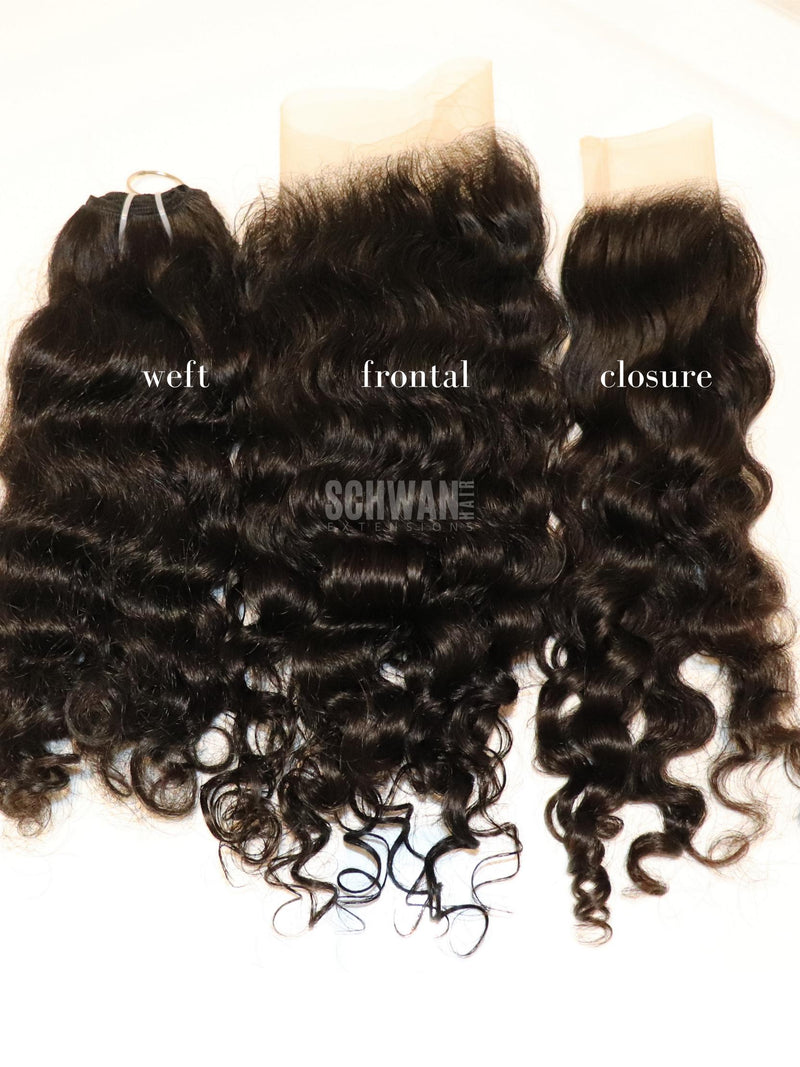
Buy from somewhere that will answer the five questions above without hedging. We sell raw hair bundles, closures and frontals from single donors, and we are happy to tell you exactly what each one is and what it will not do. Ask us anything, or start with what is raw hair if you want the full background first.