


Wig Density Explained: 130%, 150%, 180% and 250% Compared
Length gets all the attention. You pick 22 inches or 26, you picture how it will sit, you order. Density is the specification that actually decides whether the wig looks like your own hair or like a wig, and most people choose it last, or let someone else choose it for them.
Here is what it means, what each level actually looks like, and why the number on the label is less useful than you think.
The short version. We sell density in grams, not percentages, because a percentage is an opinion and a gram is not. 300g is our lightest and suits shorter lengths. 400g is the right answer for most people. 500g stays full through the ends on long hair. 600g is maximum volume. Everything below is why, and what each one actually looks like.
What density actually measures
Density is how much hair is attached to the cap. Not how thick each strand is, not how long the hair is, just how much of it there is.
The convention is to express it as a percentage, where roughly 100% represents an average head of growing hair. So 150% means about one and a half times that. It is a measure of volume, nothing else. A high density wig is not a better wig, and a low density wig is not a cheap one. They are different looks, and one of them is probably wrong for you.
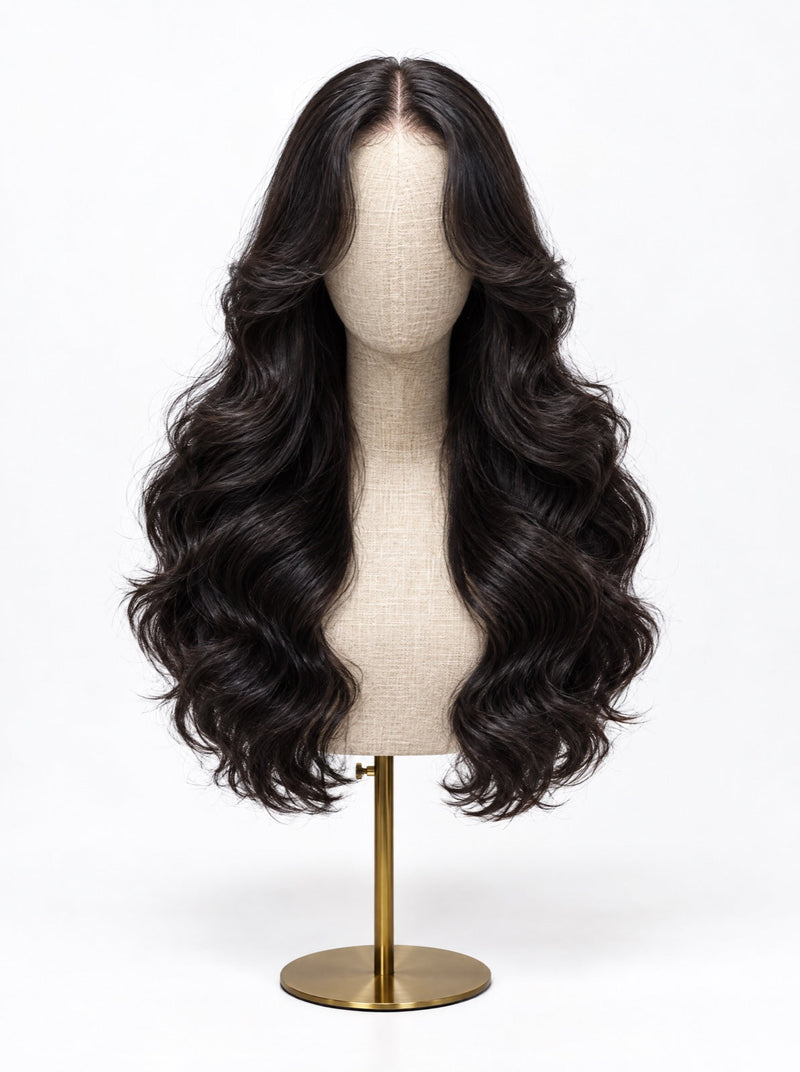
The four photographs below are all the same texture and all 24 inches, on the same mannequin, in the same light. Only the amount of hair changes.
130%, 150%, 180% and 250% side by side

All four at a glance, then each one on its own below.


Two of those are here for scale rather than sale. We build from 300 grams up, which is the third column and above. If you want the lighter looks, go shorter rather than thinner.
Length changes everything
This is the part that catches people out, and it is why we will not sell certain combinations.
Density is a total amount of hair, and that total has to cover the whole length. Spread 300 grams over 16 inches and it looks generous. Spread the same 300 grams over 30 inches and it looks thin, because the same hair now has nearly twice the distance to travel. The ends are where you notice it first: they go stringy and see-through.
So density and length are not two separate decisions. The longer you go, the more hair you need just to stay at the same apparent fullness. A 16 inch wig at a modest density can look thicker than a 30 inch wig at a high one.
Our Build Your Own Wig builder enforces this rather than leaving it to chance. From 28 inches it will not let you go below four bundles, and at 40 inches it requires six. Not an upsell, a floor. We would rather lose the order than make something that arrives looking sparse at the ends.
The problem with percentages
Here is the uncomfortable part, and it is worth knowing before you compare two sellers.
There is no standards body for wig density. No independent test, no certification, nobody checking. Every seller decides for themselves what their 180% means. One brand's 180% can hold noticeably more hair than another brand's 180%, and both are telling the truth as they understand it.
Which means comparing percentages between two shops tells you almost nothing. You are comparing two opinions.
Why we quote grams instead
Weight is not an opinion. A bundle is 100 grams on anyone's scales.
So when you build a wig with us, density is not a percentage, it is a number of 100 gram bundles:
- 300g (3 bundles), for a natural everyday look at shorter and mid lengths
- 400g (4 bundles), the most versatile choice, and the minimum from 28 inches
- 500g (5 bundles), full through the ends, holds up at long lengths
- 600g (6 bundles), maximum volume, and the minimum at 40 inches
You can weigh it when it arrives. You cannot weigh a percentage.
If you want to translate from the percentages you have seen elsewhere, here is what each of those looks takes to build from us, at 24 inches, the length the photographs above were shot at:
- 130%, about 200 to 250g, roughly 2 to 2.5 bundles
- 150%, about 250 to 300g, roughly 2.5 to 3 bundles
- 180%, about 300 to 400g, roughly 3 to 4 bundles
- 250%, about 400 to 600g, roughly 4 to 6 bundles
The length anchor matters, and it is the part most charts leave out. A bundle is 100 grams whatever length it is, so the longer the hair, the further that same 100 grams has to travel. If you see a seller quoting lighter weights against the same labels, they are almost always quoting for short wigs, where less hair goes further. Most sellers publish no weights at all, only adjectives.
Read that against our own list and you can see where we sit. Our lightest build, 300 grams, already starts where we would call 180%, and 600 grams is a genuine 250%. We do not build below 300 grams, because at the lengths we make, less than that will not hold up. Treat the percentages as a rough translation rather than a promise, because a percentage is still only an opinion. The gram figure is the one you can put on a scale.
Texture changes how density reads
The same weight looks different depending on the hair.
Curl and wave occupy more space than straight hair does, so a curly wig at a given weight looks fuller than a straight wig at the same weight. Strand diameter matters too. Our Cambodian is the coarsest and thickest in diameter we carry, our Indian is the finest, and 400 grams of each will not look identical on the same head.
If you are choosing between textures as well as densities, read the texture guide first and pick the hair, then the weight.
One thing about single donor hair
We build from single donor hair, which places a real constraint on very high densities that is worth being honest about.
Six hundred grams of colour matched, texture matched hair from one donor is simply harder to source than six hundred grams gathered from wherever. That is the trade-off of the model we have chosen. It is also why we do not offer unlimited density at every length, and why you will find sellers offering more hair for less money than we can. They are not doing anything clever. They are mixing donors.
If you want to understand what that actually changes in how a wig wears, we have written about single drawn, double drawn and the super double drawn problem separately.
So which one
Be honest about the life the wig is going into.
- You want it to pass as your own hair. 300g, and go shorter rather than longer.
- You want it to look like a very good hair day. 400g. This is the right answer for most people.
- You want it to look like money. 500g, especially past 24 inches.
- It is for the camera, the stage, or you simply love big hair. 600g, and accept the weight and the drying time.
And measure your head before you order anything, because the best density in the world will not save a cap that does not fit. We have a step by step guide to measuring, and it takes two minutes.
When you are ready, you can build the whole thing yourself: texture, length, density, cap and lace, with the price updating as you go. Or see what is already made.